The 5 Best Social Proof Software Tools for 2026 [10 Reviewed]
Your prospects trust other people more than they trust you. We've tested 10 social proof software tools and picked the 5 best to help you collect, display, and convert clients with confidence in 2026.
Martine Hammar
May 19, 2026
Your prospects have never been more sceptical. They've seen every ad, ignored every landing page headline, and developed an almost superhuman ability to tune out anything that feels like marketing. The only thing that still cuts through? Other people saying you're worth it.
Social proof isn't a nice-to-have anymore. It's the difference between a visitor who bounces and a visitor who buys. But collecting it, displaying it, and making it actually work on your website? That's where most businesses drop the ball.
I've tested 10 social proof software tools so you don't have to. Here are the five that are actually worth your time.
Before we get into the tools, it's worth being honest about what social proof software actually needs to do. At its core, it has one job: make a stranger trust you enough to take the next step.
The problem is most tools in this category are obsessed with displaying social proof - widgets, carousels, pop-ups, walls of love - without thinking nearly hard enough about collecting it. Getting a customer to leave a testimonial is the hard part. If your tool makes that process clunky, long-winded, or impersonal, you're already losing.
The second thing I look for is authenticity. A wall of five-star text reviews that all sound vaguely the same doesn't move the needle the way it used to. People have become very good at spotting templated feedback. Video changes this entirely - it's much harder to fake, and a real person on camera saying your product changed their business is worth more than a dozen written blurbs.
With that in mind, here's what I actually used to evaluate these tools:
How easy is it to collect testimonials from real customers?
Does it support video, or just text?
How does the display look on an actual website?
Is the pricing honest or does it require a maths degree to figure out what you'll pay?
Let's get into it.
The 5 best social proof software tools
1. StoryPrompt
Best for Video-First Social Proof
If you've been burned by text testimonials that sound like they were written by ChatGPT or Claude, StoryPrompt is the antidote. The whole platform is built around the idea that video is more trustworthy than text - and they've thought harder about the collection side of that equation than anyone else I've tested.
The thing that sets StoryPrompt apart is that you don't just send customers a form and hope for the best. You record a video prompt yourself - your face, your voice, your personality - and your customer responds in kind. The response rate difference is real. When someone gets a warm, personal video asking for their feedback rather than a cold link to a form, they're far more likely to actually record something.
Once the responses come in, StoryPrompt handles the production automatically. Filler words removed, silences trimmed, your branding applied. You end up with professional-looking video testimonials without touching a video editor.
The Wall of Love feature lets you display these on your website with an embed code, and the whole thing can be white-labelled on higher plans so it feels like your product, not theirs.
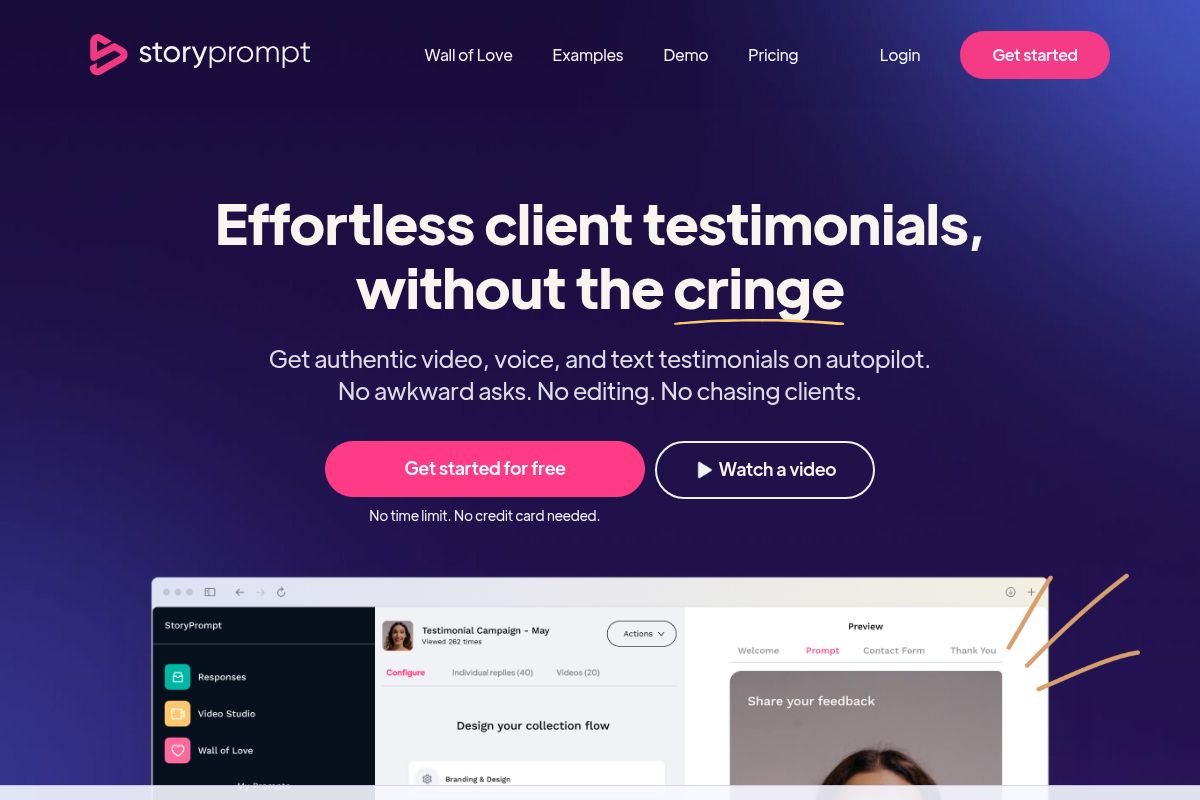
StoryPrompt: Best software for social proof on video
Pros
Video-based prompts get significantly higher response rates than text forms
Automatic video production with AI - removes filler words, adds branding
Captions burned directly onto videos
White label links on higher plans
Zapier integration
Free plan available with no credit card required
Cons
No built-in rewards or incentive system for customers who leave testimonials
Video-first approach may feel like overkill if you only need text reviews
Plans and Pricing
All prices based on annual billing:
Free - 15 video responses, 2 min per video, 1 Wall of Love with 5 testimonials, StoryPrompt watermark
Starter - $39/mo - 100 responses/month, 3 min per video, 1 Wall of Love, your own branding, downloadable videos, AI summaries
Pro - $79/mo - 200 responses/month, 5 min per video, 3 Walls of Love, 4 users, Zapier integration, custom fields
Premium - $169/mo - 400 responses/month, unlimited video length, unlimited Walls of Love, 9 users, API access, link white labelling, concierge onboarding
Summary
StoryPrompt is the only tool in this list that treats collection as seriously as it treats display. If you're in a business where trust is everything - coaching, consulting, SaaS, professional services - the video-first approach pays for itself quickly. The Starter plan at $39/mo is genuinely good value for what you get.
Senja has built what they call the most generous free tier of any social proof tool - and having tested it, that claim holds up. The free plan gives you 15 testimonials, unlimited widgets, unlimited Walls of Love, video hosting, and imports from 18 sources including Twitter, LinkedIn, and Product Hunt. That's a genuinely usable starting point, not a crippled demo.
The import feature is where Senja earns its place on this list. If you've accumulated social proof scattered across different platforms and want to pull it all into one place, Senja handles this better than anything else I've tested. The widgets are clean, the setup is fast, and the pricing is refreshingly simple compared to most competitors.
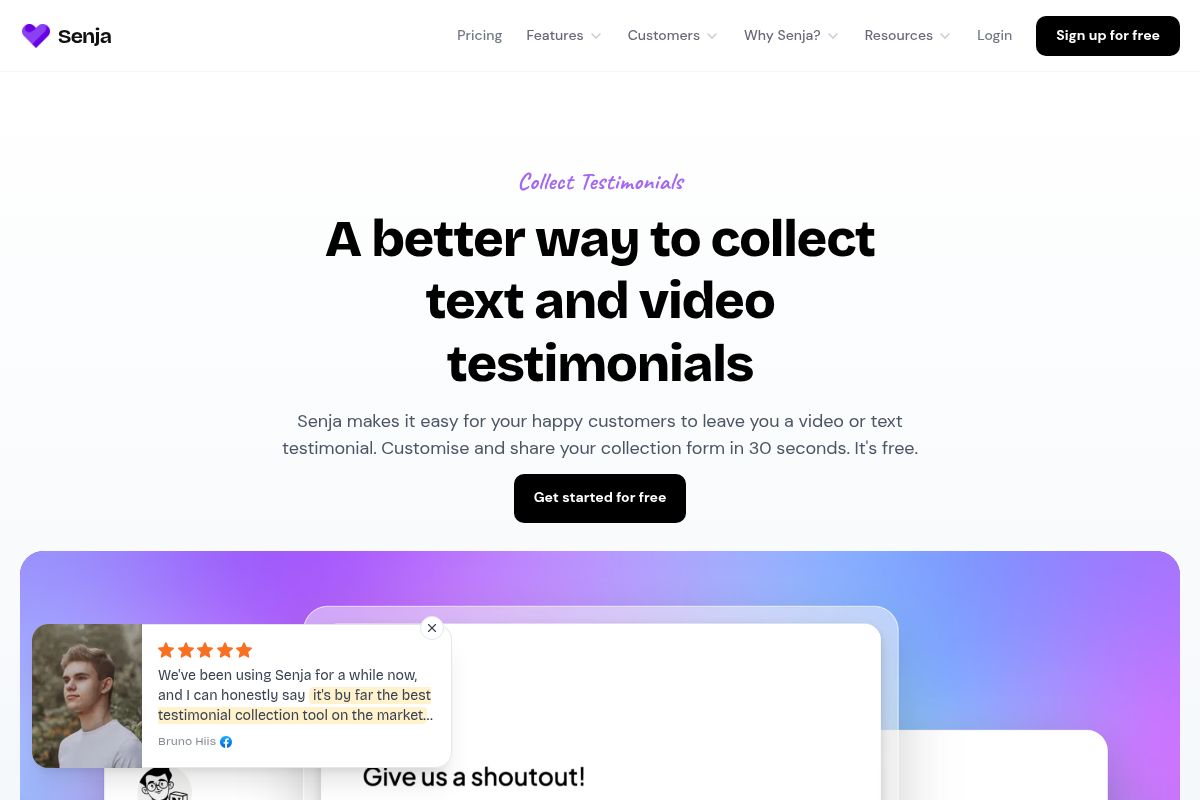
Senja: Great for collecting text social proof
Pros
Genuinely usable free tier - unlimited widgets and Wall of Love even on the free plan
Strong third-party import from 18 sources including Twitter, LinkedIn, Product Hunt
Clean widget designs that look good on most websites
API access from $29/mo Starter - more generous than most competitors
Simple, transparent pricing
Cons
Video collection is less polished than StoryPrompt - no automated production or AI editing
Built for tech-savvy indie SaaS founders, not typical client-facing businesses
Free plan capped at 15 testimonials - you'll hit it faster than you expect
Plans and Pricing
All prices based on monthly billing; annual saves 17%:
Free - 15 testimonials, unlimited widgets, unlimited Walls of Love, video hosting, imports from 18 sources, Senja branding
Pro - $59/mo - unlimited forms, 5 projects (extra projects $10/mo each), 5 seats (extra seats $5/mo each), rich snippets, translations into 20 languages
Summary
For solo founders, small SaaS businesses, or agencies on a budget, Senja is the smartest starting point. The free plan is one of the most honest in this category - and when you do need to upgrade, $29/mo for unlimited testimonials and API access is hard to argue with.
3. Trustmary
Best for Review Aggregation
Trustmary plays a different game to most tools here. Rather than focusing primarily on collecting new testimonials from scratch, it's built around pulling in reviews you've already earned on Google, G2, Tripadvisor, Capterra, and other platforms - and making them work harder on your website.
If you've been diligently collecting reviews across multiple platforms for years and feel like they're disappearing into the void, Trustmary is the answer. The display widgets are among the best designed in this category, and the automation for requesting new reviews is solid.
I'll be honest about the pricing: Trustmary still splits plans into Collect and Display tiers that you mix and match, which sounds flexible but in practice makes it hard to know what you'll end up paying. The "Build Your Plan" slider at $29/mo is a genuine entry point, but a business needing both collect and display functionality at scale will be looking at $236/mo or more. Map out exactly what you need before you sign up.
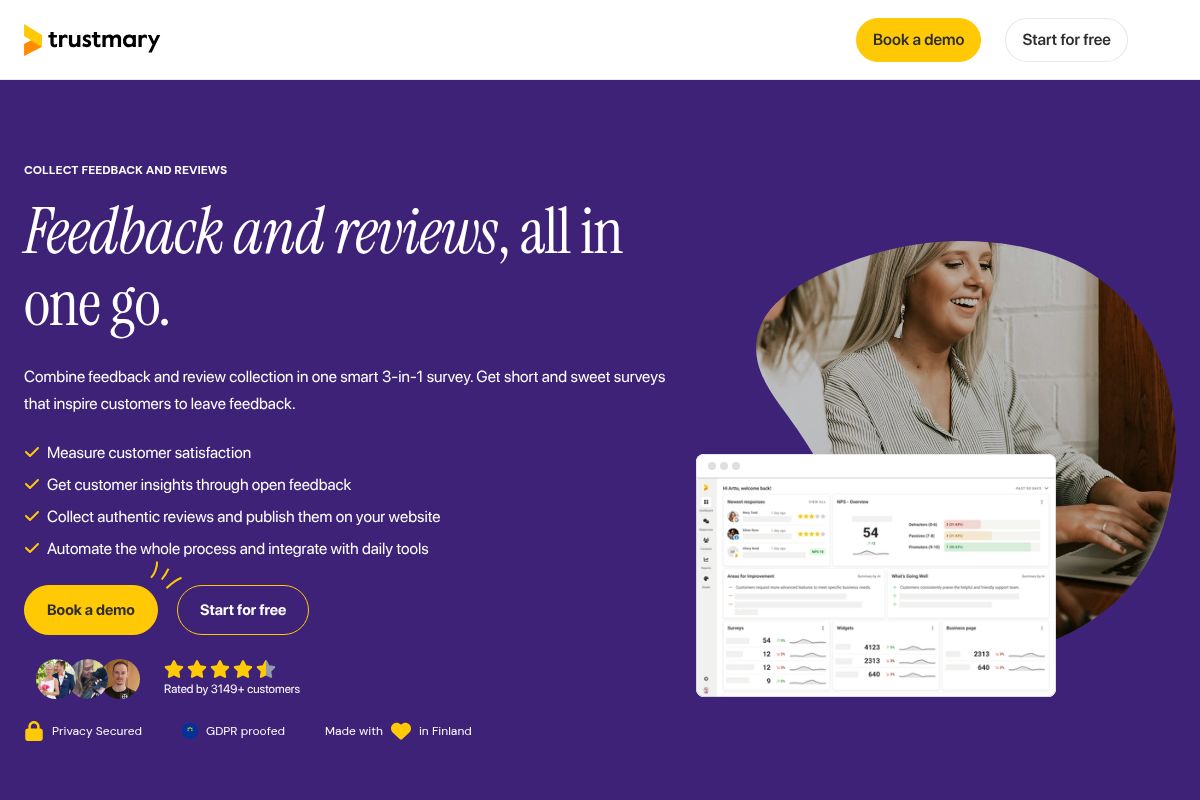
Trustmary: Feedback and reviews in one
Pros
Best-in-class review aggregation from major third-party platforms
Clean, professional-looking display widgets
Automated review request sequences
A/B testing for testimonial widgets
Free Solo plan available
Cons
Split Collect/Display pricing model is genuinely confusing - easy to underestimate your costs
Video testimonial collection feels like an afterthought compared to its review aggregation strengths
Gets expensive fast once you scale
Plans and Pricing
Trustmary uses a modular Collect/Display pricing structure. Annual billing:
Build Your Plan - from $29/mo - 5,000 widget views, 10 survey responses, usage-based slider
Starter - from $236/mo - 5,000 views with premium support
Business - from $546/mo - 25,000 views with premium support
Full Suite plans bundle Collect and Display together; contact Trustmary for a quote.
Summary
If third-party review aggregation is your priority, Trustmary is the strongest tool in this list for that specific job. Just be careful with the pricing calculator and confirm your monthly costs before committing to an annual plan.
4. ProveSource
Best for Live Activity Notifications
ProveSource does something the other tools here don't: it shows your website visitors what other people are doing right now. Recent signups, purchases, form completions - small notifications that pop up on your site in real time and create the feeling that something is happening here.
It's a different category of social proof to testimonials. Less about trust-building through stories, more about reducing hesitation through momentum. The setup is straightforward, there's a genuinely useful free plan, and the notifications are unobtrusive when configured correctly. The risk, as always, is overusing them - too many pop-ups and it starts to feel like a casino.
ProveSource: Social proof software
Pros
Real-time activity notifications highly effective for reducing drop-off on sign-up pages
Free plan includes all features for up to 1,000 monthly unique visitors
Good targeting controls - show specific notifications on specific pages
Clean, unobtrusive design options
Competitive annual pricing
Cons
Not a testimonial tool - if you need to collect and display written or video reviews, look elsewhere
Effectiveness depends heavily on traffic volume - low-traffic sites will have little to show
ProveSource is a strong addition to a social proof stack, not a replacement for testimonials. If you're running paid traffic to a landing page and want to reduce drop-off, it's worth testing on the free plan first. Use it alongside StoryPrompt or Senja rather than instead of them.
5. Fomo
Best for eCommerce
Fomo sits in the same activity-notification category as ProveSource but with a tighter focus on eCommerce. It integrates with Shopify, WooCommerce, and 100+ other tools including Klaviyo, Mailchimp, and Google Analytics, pulling in real purchase and review data to show visitors what other customers are buying.
The notification designs are polished, and the targeting rules are more granular than ProveSource - useful if you need to show different notifications on product pages versus checkout. Worth noting: there's no free plan, only a 14-day trial. If you're not yet doing meaningful eCommerce volume, ProveSource's free tier is a better starting point.
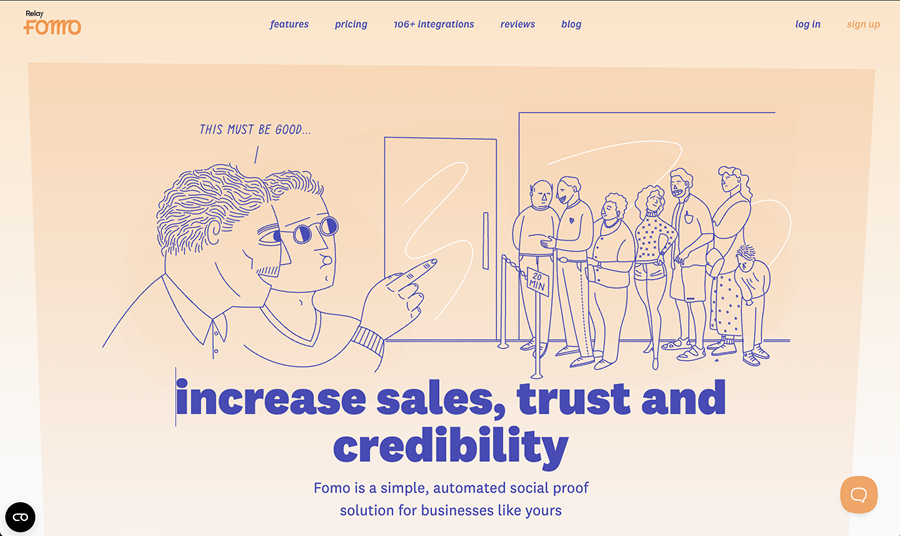
Fomo: Automated social proof solution
Pros
Strong eCommerce integrations, especially Shopify, plus 100+ app connections
Highly customisable notification rules and targeting
Clean, professional notification designs
Supports review data from multiple sources
Cons
No free plan - 14-day trial only
More expensive than ProveSource for equivalent functionality
Overkill for non-eCommerce businesses
Plans and Pricing
Annual billing (monthly is ~20% more):
Starter - $25/mo - 8,000 notifications/month, 1 site
Business - $75/mo - 40,000 notifications/month, unlimited sites
If you run a Shopify store and want to show real purchase activity to reduce checkout hesitation, Fomo is a strong option. For everyone else, ProveSource does a similar job at a lower price and with an actual free plan to get started.
The best of the rest
Testimonial.to- A solid Wall of Love tool with a decent free plan (10 text, 2 video testimonials). Paid plans run $20-$70/mo annually, which is competitive. The multi-space pricing gets expensive fast for agencies though, and their live chat support was slow when I tested it.
Boast - Good for NPS surveys and automated email sequences for pushing customers toward reviews. Still no free plan in 2026 - the Basic plan starts at $50/mo annually for 600 responses/year at 720p. Hard to justify when Senja and StoryPrompt both offer free tiers.
Yotpo - The enterprise standard for eCommerce reviews, now focused purely on Reviews and Loyalty after sunsetting its Email and SMS products in December 2025. Reviews start at $79/mo, Loyalty at $199/mo. The Pro bundle (Reviews + Loyalty) runs around $368/mo. Only makes sense once your Google Shopping and loyalty programmes justify the cost.
Trustpilot - The brand recognition is still real, and their new $99/mo Starter plan (launched in 2026) makes it accessible for smaller businesses for the first time. But the Plus plan at $319/mo per domain and Premium at $799/mo per domain are serious commitments, billed annually upfront. Worth it if search-stage trust signals directly influence your purchase decisions - less so if you're primarily selling through inbound or referral.
Repuso - A straightforward aggregator that pulls reviews from social media and displays them on your site. Does the job without fuss. Less polished than Senja for the same use case, and Senja's free plan is more generous.
The bottom line
Most businesses are leaving social proof on the table - not because they don't have happy customers, but because their collection process is too passive. A link in an email asking for a testimonial gets ignored. A video from a real person asking a specific question gets answered.






.jpg)

.jpg)